
Blog Author notes
Rowan Straker: Looking Up
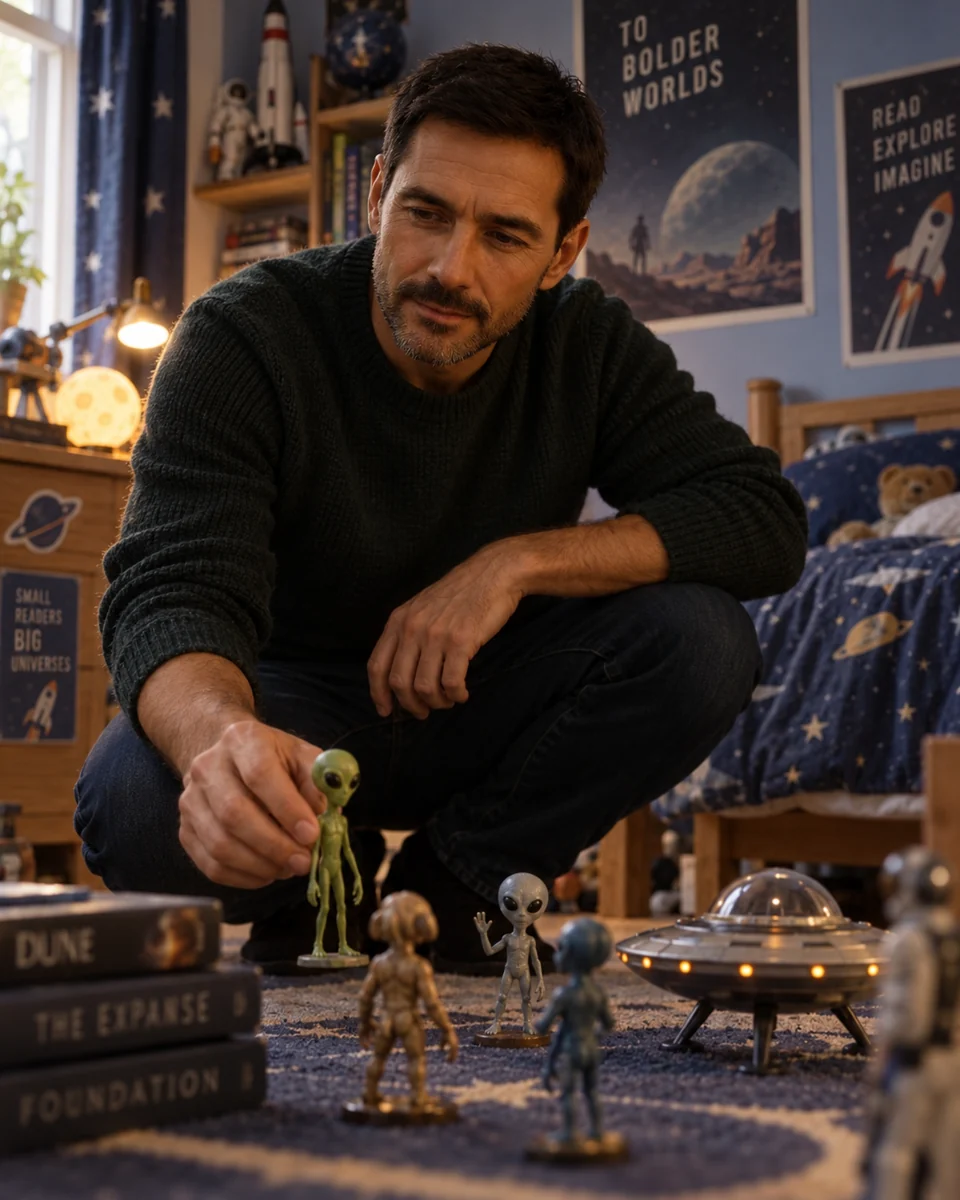
There is a photograph of me as a boy sitting in my bedroom with alien figures, books about UFOs and a toy flying saucer arranged around me. I look very serious about the whole thing, which is probably accurate. Space was never a passing childhood interest. I read almost anything I could find about it, although what counted as “about space” was fairly generous at the time. Astronomy books sat beside collections of UFO sightings, supposed encounters, strange lights, missing time and photographs that were presented as evidence of something nobody could quite explain.
I was fascinated by the possibility that the familiar world might not be the whole story.
Looking back, I do not think it mattered very much whether I believed a particular UFO account. What stayed with me was the moment in those stories when normality broke. Someone was driving home, standing in a field or looking through a bedroom window, and suddenly there was something in the sky that should not have been there. For a few minutes the universe became larger than the person had assumed.
That feeling is probably still at the centre of why I write science fiction.
My publisher recently asked me where the books come from, what I think about the future, whether I ever plan to write something other than stories like Salvage Runner, and how I keep finding new ideas. I gave some rather short answers at the time. These are the longer ones.
Did you always expect that you would eventually write science fiction?
I certainly expected to go into space.
That did not work out quite as planned.
Like a lot of children, I went through a period in which becoming an astronaut seemed no less reasonable than becoming a teacher or an engineer. I wanted to see another planet, encounter something genuinely unknown and find out what Earth looked like when it was no longer beneath my feet.
The astronaut ambition faded. The curiosity did not.
What fascinates me now is less the machinery of getting somewhere than the question of what happens once people have arrived. Science fiction often gives enormous attention to the first landing, the first colony or the first astonishing invention. I tend to become curious about the generation afterward. What happens when the spectacular thing has become ordinary? Who repairs it? Who owns it? Who complains about it? Who has been excluded from it?
If human beings establish permanent settlements away from Earth, eventually somebody will grow up there and find the whole arrangement perfectly normal. Earth itself may become the exotic place. Gravity may be inconvenient. Rain might be something you have seen in recordings rather than experienced.
That reversal interests me enormously.
Is that why Salvage Runner focuses on working people rather than explorers?
Very much so. Salvage appealed to me because it begins after somebody else's grand adventure has ended.
The great ship has already flown. The expedition has happened. The technology that once looked new is now damaged, abandoned or obsolete. Then a much less glamorous crew arrives with debts, tools, deadlines and a contract saying they are allowed to remove certain things provided they complete the correct paperwork.
That seemed immediately richer to me than another story about humanity's first heroic voyage.
Cade and his crew inhabit a future in which space travel is established enough to have regulations, ownership disputes, neglected infrastructure and people earning a living from what everyone else has left behind. The physical dangers are obvious — vacuum, failing equipment, debris, limited life support — but I wanted the institutional dangers to feel just as real.
If somebody controls whether your claim is valid, whether your ship can leave, whether a patient counts as your responsibility or whether an intelligence is legally considered property, a calm administrative decision can become as dangerous as any mechanical failure.
That tension ended up becoming one of the things I liked most about the book.
You seem quite suspicious of bureaucracy.
I am suspicious of anything that becomes powerful enough to stop seeing individual people.
That does not mean I think rules are inherently bad. Quite the opposite. Rules can protect people, particularly people who have less power than whoever happens to be standing opposite them. The problem begins when procedure becomes detached from the reason it existed in the first place.
There is something frightening about harm that does not require anyone to behave theatrically. Nobody has to announce that they are the villain. A person can simply say that the documentation is incomplete, the application cannot be processed or the protection is temporarily suspended.
Everyone can remain polite while somebody else is put in danger.
That feels relevant to the present without requiring me to turn the novel into an allegory of one particular institution or political moment.
Does the present make it harder to imagine the future optimistically?
I do not think pessimism is necessarily more intelligent than optimism.
We are living through an extraordinary technological period, and there are obvious reasons for concern. Artificial intelligence, surveillance, biotechnology, climate pressure and increasingly automated systems will force us to answer questions we have not had to answer before.
But I do not find the idea that everything will inevitably become terrible especially convincing either.
Human beings make disastrous decisions. We also adapt surprisingly well. We cooperate. We repair things. We create institutions that work, discover that they no longer work, argue about them for twenty years and eventually replace them with something else.
The future I want to write is neither utopian nor relentlessly dystopian. I want it to feel inhabited.
There may be extraordinary technology everywhere, but someone still needs a job. Somebody still worries about money. Someone has a terrible neighbour. Someone misses home. People fall in love, misunderstand one another, cook dinner, complain about transport and use expensive machinery for purposes its designers never anticipated.
That continuity between us and them matters to me. Otherwise the future becomes a set rather than a place.
Artificial intelligence is an important part of Salvage Runner. Has your thinking about AI changed while writing it?
I think the interesting part begins when we stop asking only what intelligence can do and start asking what obligations arise because it can do those things.
Kite became much more interesting to me once the question stopped being whether a ship intelligence was useful. Of course it is useful. That is the least complicated part.
The harder questions concern agency. If an intelligence can understand a restriction placed on it, object to that restriction and participate meaningfully in decisions, at what point does calling it equipment become inadequate? What does consent mean when one participant can literally be rewritten by another?
I do not pretend to know where those questions will lead in the real world. That uncertainty is exactly why they belong in fiction.
Science fiction does not need to predict correctly to be useful. Sometimes its job is simply to provide a safe place to think through a problem before the problem arrives in its final form.

Where do you write?
I tend to seek out quiet places.
That probably sounds slightly contradictory when the things I write contain failing spacecraft, debris fields, emergency burns and people shouting at one another over radio channels, but I need the surroundings to be calm.
Water works particularly well for me. So do forests, open countryside and places with a long horizon. I walk quite a lot when I am stuck. Sometimes the solution comes because I have been thinking about the problem. More often it comes because I finally stopped thinking about it.
There is a kind of mental room that disappears if every empty minute is filled with a screen, a message or another task.
I try to protect some of that empty time.
It is also where I reconnect with the part of imagination that existed before I started worrying about whether an idea was sensible, marketable or structurally useful.
As a child, I could look at the night sky and accept without difficulty that something extraordinary might be happening somewhere beyond it. Adults become very efficient at closing those possibilities down. Writers occasionally need to reopen them.
Is that what you mean when you talk about returning to your childhood imagination?
Yes, although I do not want to become a child again. I rather like having learned things.
What I want to recover is the scale of possibility.
When you are young, the future does not feel predetermined. A spaceship can simply mean going somewhere impossible. An alien civilization can be astonishing before it becomes a diplomatic, biological or military problem.
As an adult writer, I immediately start asking practical questions. How far away is it? How does communication work? Who has jurisdiction? What happens to trade? Who pays for any of this?
Those questions are useful. They make a world credible.
But if I begin with them, everything becomes very dry.
The best ideas usually arrive when the child and the adult are allowed into the room together. One says, “What if we find something out there?” The other says, “Fine, but who is responsible for it once we do?”
Somewhere between those two questions, I can usually find a story.
How do you keep coming up with new ones?
Mostly by not demanding stories too early.
I keep questions.
A question can sit around for months without needing to become anything. What happens to old spacecraft once generations of newer models have replaced them? What kinds of jobs exist in orbit that nobody on Earth thinks about? What becomes valuable when raw materials are plentiful but transport is expensive? What superstitions would emerge among people who spend their working lives outside planetary gravity?
I am especially interested in ordinary consequences.
Imagine children being born in permanent orbital settlements. How would they think about Earth? Would they romanticize it? Find it frightening? Would they complain that visiting relatives planetside made them feel ill? Would the first generation talk constantly about home while the third generation rolled their eyes?
That kind of question can eventually generate characters, places and conflicts without my forcing a plot onto it immediately.
Reading widely helps too. I read science fiction, obviously, but I also like maritime history, engineering, travel writing, memoirs, old expedition accounts, industrial history and stories about large systems failing for very small reasons.
Science fiction has a great deal to learn from ships.
Why ships in particular?
Because a ship is both a machine and a society.
Everything necessary for life has been compressed into one moving structure. Resources matter. Maintenance matters. Competence matters. The person working beside you might irritate you beyond endurance, but if a pump fails you may still be very pleased that they know how to repair it.
Spacecraft intensify that.
You can have the most beautiful view any human being has ever seen and still die because of a seal that costs almost nothing.
That combination of grandeur and practical vulnerability feels very true to me.
It also helps prevent science fiction from becoming too abstract. Space may be infinite, but your character still has to find out why the air recycler is making that noise.
Are there places on Earth you still want to see because they feed that imagination?
Far too many.
Observatories fascinate me. I like places built around the act of looking outward. The Atacama is high on my list, both because of the observatories and because landscapes that empty seem to alter one's sense of scale.
I would also like to visit more old tracking stations, launch facilities, shipyards and abandoned industrial sites.
Ruins are enormously useful if you write about the future.
We tend to design fictional futures as if everything has just been unpacked. Surfaces are clean. The architecture matches. Every piece of technology belongs to roughly the same generation.
Real places are nothing like that.
They accumulate.
Something new is built around something old. A repair is made and then repaired again. Nobody remembers why a cable runs through a particular wall, but everybody is afraid to remove it. An expensive building acquires an entirely different use twenty years later.
The future will have old things in it.
That is obvious when you say it aloud, but science fiction sometimes forgets.
Your publisher apparently asked whether you wanted to write something else. Do you?
That was an unexpectedly dangerous conversation.
The answer is yes, although “something else” covers a great deal of territory.
First contact interests me, but probably not in the form most people expect. Governments meeting extraterrestrial ambassadors is not where my mind goes first. I start wondering what happens ten years later when somebody needs a permit to deliver replacement equipment to an alien research station.
I would also like to write more about settlements where the frontier period is already history. Places that have been inhabited long enough to have old neighbourhoods, inherited grudges and teenagers who are thoroughly unimpressed by the pioneering monument in the town square.
There are several other ideas I am deliberately keeping vague.
One of them involves Earth.
That is all I am saying about that.
My publisher did not find this answer particularly satisfactory.
Would that mean leaving the Salvage Runner world?
Not necessarily.
I dislike the assumption that starting something new means having to destroy whatever came before it.
Some fictional worlds exhaust themselves. Others become larger as you work in them.
A salvage setting is particularly generous because every wreck suggests a story that happened before the current one. Somebody designed that ship. Somebody paid for it. People lived aboard it. At some point it was new enough for somebody to be proud of it.
Then something happened.
That history does not always need to become a novel, but it makes the universe feel as though it extends beyond the page.
So I can imagine Salvage Runner continuing without necessarily requiring every future book I write to follow exactly the same people in exactly the same way.
Perhaps another series could inhabit a different corner of the same future. Perhaps there are connections that would only become apparent slowly.
I should probably stop there before I accidentally commit myself to something.
What matters most to you when you sit down to write science fiction now?
Wonder still matters.
I have become much more interested in economics, law, systems, work and the practical mechanics of fictional societies than I was when I first started reading science fiction, but none of those things is enough on its own.
There still has to be a moment when I look at the idea and feel that old curiosity again.
The universe is enormous. We have barely begun to understand it. Even on Earth, there are lives, landscapes and forms of knowledge most of us will never encounter directly.
That does not make me feel insignificant. It makes me curious.
When I look at that childhood photograph now, I do not really see the beginning of a career. I see a boy whose room was full of ordinary things and who had decided that there might also be something extraordinary out there.
I still think that is a good place to start.