
The story is troll-centred, with a strong non-human perspective. Conflict is driven by internal debate, ecological pressure, and competing ideas of stewardship rather than battles or prophecy.
Available now
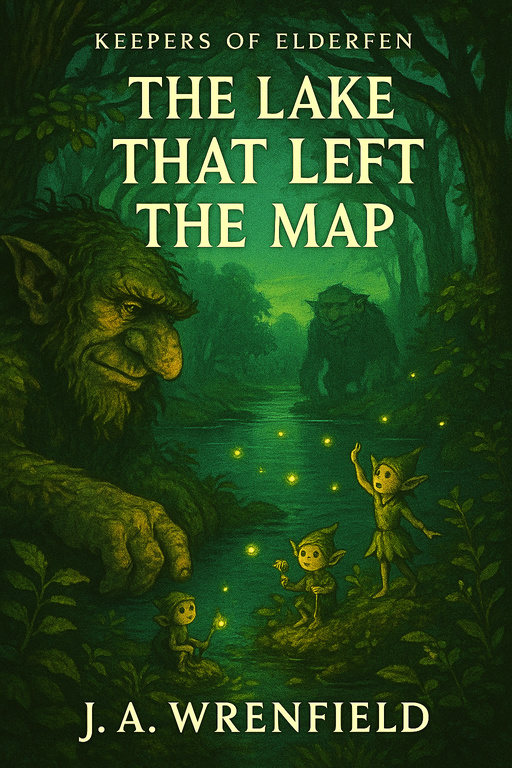
The Lake That Left the Map
Keepers of Elderfen · Book 1
The Lake That Left the Map When a troll healer finds blank labels on her shelves where inlet names used to be, she knows something is feeding on Elderfen Lake.
The Lake That Left the Map When a troll healer finds blank labels on her shelves where inlet names used to be, she knows something is feeding on Elderfen Lake. Not draining it—erasing it. Paths forget where they lead. Birds that have landed there for generations fly over without looking down. And beneath the water, an ancient mechanism is keeping score. Mossheart has spent her life holding Elderfen together with remedies, root-maps, and sheer stubbornness. Grimdor, the lore-keeper, guards its stories in carved stone. But when a drought-stricken western clan begins weaponizing the lake's own magic—feeding it erasures in exchange for water—the two keepers discover that their enemy isn't a monster. It's a ledger. And the ledger is honoring what it's been taught: that this place's time is over. Their only ally from the human world is Elias, eighteen years old and carrying his dead mother's field notebooks. He can't see the trolls. He can't read the root-maps. But he can do something none of them can: refuse to let a lake be written into the past tense. To save Elderfen, they'll need to rewrite a contract that no one fully understands, broker peace with a clan that has every right to be furious, and convince a power older than language that attention is worth more than erasure. The cost of failure isn't destruction. It's worse: a place that simply stops being remembered, one form at a time, until even the people who loved it can't recall what they lost.
Available as an eBook and paperback.
$6.99 USDBuy eBook$15.99 USDBuy Paperback
PublicationAvailable
FormatsKindle eBook & Paperback
Publication dateFebruary 15, 2026
Edition1st
Kindle print length293 pages
ISBN978-9190145135
Kindle ASINB0GNK5KT6V
LanguageEnglish
ExtentFull-length novel
Paperback pages240 pages
Word count91,800 words
GenreMythic fantasy / Ecological fantasy / Secondary-world fantasy
SeriesKeepers of Elderfen
Book in seriesBook 1
Story scopeFirst book in The Elderfen series
ToneThoughtful, restrained, quietly urgent; mythic without spectacle
PublisherUTP House
Fantasy with non-human societies, environmental themes, moral complexity, slow-building tension, and worlds where magic functions through rules, memory, and consequence.
Themes of environmental degradation, historical sacrifice, internal political conflict, displacement, and past violence within a mythic context; no graphic violence.
Read
Read an excerpt
“The Guardian of Timeless Renewal,” Mossheart said quietly. “That is the closest your words can get.” Elias had expected something grander. “Guardian,” he repeated. “Like a… spirit?” “Like a rule that learned to wear a shape,” Grimdor said. “Not a person. Not a thing. A way of keeping track of exchanges. Every time someone handed over something that mattered, the Guardian learned: offerings in, blessings out. Fair trade.” He marked another symbol, a small wave-line crossing the first. “Then came prayers,” Grimdor went on. “Less metal, more words. People sang. They promised. They made vows. The Guardian listened. It noticed that spoken things also counted. If a promise was earnest enough, it weighed as much as a bracelet.” “And then came your kind of offerings,” Mossheart said to Elias. “Lists. Registers. Little marks on maps. At first, they were crumbs to the Guardian—small, thin things. But your people built big bones out of them. Offices. Laws. Funds. They wrapped rivers and forests in words and numbers until those mattered more than the mud itself.”
Listen
Listen to an excerpt
The audio sample slot is ready. A player will appear here when the recording is added.
Audio sample in preparationComplete title informationThe Lake That Left the Map
A lake that refuses to be owned.
When Elderfen begins to vanish from human maps, the keepers of the lake know it is not a clerical error. Names matter here. Lists matter. And erasure has weight.
As water shifts and paths thin, a circle of guardians—trolls, healers, watchers of root and stone—gathers to trace what is being lost. To the west, dry channels bite deeper each season. To the east, careful traditions strain under the pressure to hold the line. Between them lies Elderfen: a living lake bound by old contracts, newer bureaucracies, and a Guardian that has learned to count offerings of many kinds.
Elias, a human who works with registries and coordinates, is drawn into the conflict when he realizes that every tick in a distant ledger feeds a change in the land. What begins as a question of classification becomes a reckoning over sacrifice, responsibility, and whether balance can be negotiated without repeating the violence of the past.
The Lake That Left the Map is a myth-inflected fantasy about environmental governance, shared stewardship, and the dangerous simplicity of deciding who—and what—counts. It asks not how to control a living system, but how to remain in relationship with it.
Story
“The Guardian of Timeless Renewal,” Mossheart said quietly. “That is the closest your words can get.” Elias had expected something grander. “Guardian,” he repeated. “Like a… spirit?” “Like a rule that learned to wear a shape,” Grimdor said. “Not a person. Not a thing. A way of keeping track of exchanges. Every time someone handed over something that mattered, the Guardian learned: offerings in, blessings out. Fair trade.” He marked another symbol, a small wave-line crossing the first. “Then came prayers,” Grimdor went on. “Less metal, more words. People sang. They promised. They made vows. The Guardian listened. It noticed that spoken things also counted. If a promise was earnest enough, it weighed as much as a bracelet.” “And then came your kind of offerings,” Mossheart said to Elias. “Lists. Registers. Little marks on maps. At first, they were crumbs to the Guardian—small, thin things. But your people built big bones out of them. Offices. Laws. Funds. They wrapped rivers and forests in words and numbers until those mattered more than the mud itself.”
$6.99 USDBuy eBook$15.99 USDBuy Paperback
Back to J.A. Wrenfield's books →