
The Memory of Frost is a quiet, character-driven Nordic near-future story with more tension than spectacle: fieldwork on a frozen lake, ethics hearings, and community meetings carry as much weight as the storm and AI plot. It’s a standalone novel in the Norn Protocol universe, with strong Sámi perspectives, some Sámi terms (glossed in context), no on-page romance, and an AI that is treated as a contested tool rather than a monster or messiah.
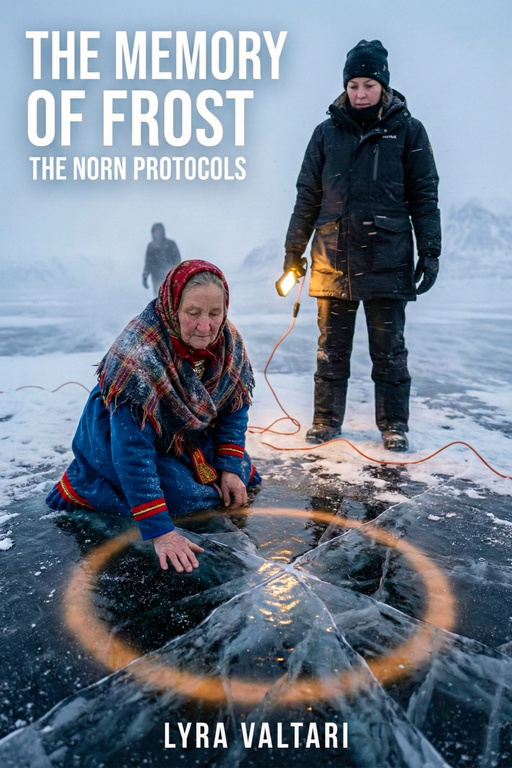
Available now
The Memory of Frost
The Norn Protocols · Book 1
A scientist, a Sámi elder, and an AI that knows too much about a frozen lake.
A scientist, a Sámi elder, and an AI that knows too much about a frozen lake. Decades ago, a Sámi woman named Elle Márjá sat in a clinic in Kiruna and let researchers record her brainwaves while she listened to her own joik. She signed a form. She took the money. She went home. She did not imagine those patterns would ever glow on a different screen. Now a research team has deployed an AI system called Lyra to the shores of Torneträsk — and Lyra is dreaming in patterns that look uncannily like Elle Márjá's. As neuroscientist Elin pushes the project forward, field researcher Naja begins to see that the data isn't just data, and the corporation funding the work has plans that none of them agreed to. A novel about ice, memory, and the moment a machine begins to remember something it was never taught. Book 1 in The Norn Protocols.
Available as an eBook and paperback.
PublicationAvailable
FormatsKindle eBook & Paperback
Publication dateFebruary 13, 2026
Edition1st
Kindle print length374 pages
ISBN978-9190145289
eBook ASINB0GN9NRTVR
Paperback ASIN9190145372
LanguageEnglish
ExtentFull-length novel
Paperback pages295 pages
Word count122,000 words
GenreLiterary eco-fiction / ethical contemporary fiction
SeriesThe Norn Protocols
Book in seriesBook 1
Story scopeBook one in The Norn Protocols series
ToneMeasured, intimate, and quietly tense. The book moves like slow-building ice pressure rather than nonstop action: grounded in sensory realism, clipped dialogue, and steady emotional undercurrents.
PublisherUTP House
Snowbound, small-team science fiction; indigenous futurism and land-centered SF; ethical dilemmas about AI, consent, and data sovereignty; tense but grounded rescue sequences in extreme weather; stories where community councils and family kitchens matter as much as labs and servers.
Contains depictions of severe winter storms, ice risk, and rescue on a frozen lake; references to a past drowning accident and survivor guilt (no graphic detail); corporate exploitation of indigenous data, including misuse of historical EEG recordings; reindeer distress linked to experimental technology; and some medical emergency scenes. No torture, sexual violence, or graphic gore.
Read
Read an excerpt
Naja stared at her.
Elin flushed.
“I’m not saying we hide it forever,” she said quickly. “I’m saying timing matters. We’re in the most fragile phase. One badly framed conversation could turn into a political storm that buries Lyra.”
“Trust depends on timing too,” Naja said. “We told Hætta there was nothing like this. We told Sanna the legacy sets were clean. We told ourselves we were different from the men in that clinic. How much longer do you want to postpone being honest before you become them?”
Elin’s expression hardened.
“That’s unfair,” she said. “We are not strapping anyone into chairs and dragging them into rooms.”
“No,” Naja said. “We’re pulling extra meaning out of recordings taken that way and not telling the people most affected.”
Elin opened her mouth, shut it, then reached for the teapot and refilled her mug with movements that were a little too sharp.
Listen
Listen to an excerpt
The audio sample slot is ready. A player will appear here when the recording is added.
Audio sample in preparationComplete title informationThe Memory of Frost
When research meets memory.
When a winter research team arrives at a northern lake to test new monitoring technology, they know the rules: get permission, minimise impact, leave no trace. The ice is unstable, the reindeer herds are sensitive to disturbance, and the people who live here have long memories of what happens when outside projects move too fast.
Elin has worked hard to keep her past separate from her profession. But this place will not cooperate. Old routes are avoided without explanation. Certain stretches of ice are never crossed. And a childhood accident—officially closed, never fully spoken about—begins to press into the present as decisions pile up.
As the project advances, every choice becomes a negotiation: between data and safety, innovation and restraint, scientific authority and local knowledge. Nothing dramatic announces itself. The danger lies in what is normalised, postponed, or quietly justified.
The Memory of Frost is a precise, ethically charged novel about research in fragile landscapes, the limits of technical solutions, and the way land remembers what people prefer to forget. It is not about uncovering secrets—but about learning when not to proceed.