
The central set-piece is a campus-wide blackout drill tied to a copper-lined chamber beneath the library and an elite society’s influence network.
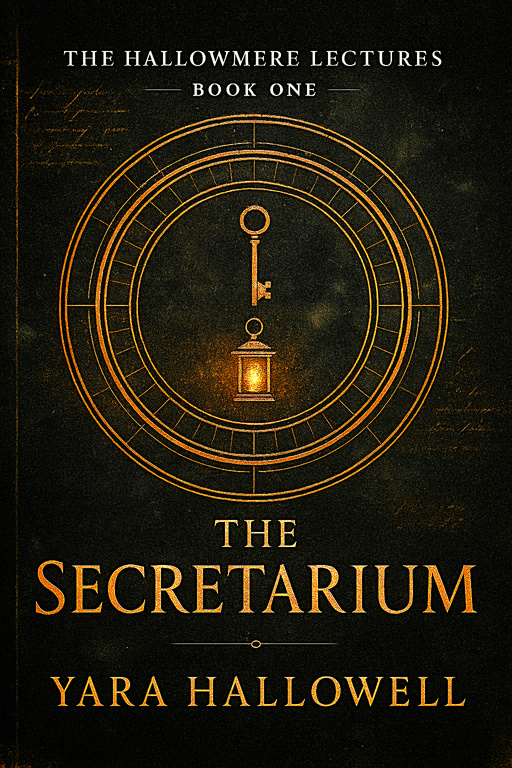
Available now
The Secretarium
The Hallowmere Lectures · Book 1
Leda Morrell was thrown out of Hallowmere College for asking dangerous questions. Now the Dean has invited her back — on a leash — to sort through the papers of her dead mentor.
Leda Morrell was thrown out of Hallowmere College for asking dangerous questions. Now the Dean has invited her back — on a leash — to sort through the papers of her dead mentor. Professor Harrow left behind a wheel. Thirteen positions. Dates that align with student deaths the College prefers to call accidents. And a note: Start with the bell. Beneath the library, copper lines hum with a frequency that predates the wiring. During blackout drills, names move through the system — onto rosters, into files, off the record. The College doesn't sacrifice its students. It processes them. And the paperwork is always immaculate. With a disgraced archivist's access, an ex-lover on the inside who may be complicit, a student who survived the bell tower by spite alone, and a network of zine-printing troublemakers who've been mapping the patterns no one wants to see — Leda has one term to expose a machine that has been running, quietly and efficiently, for longer than anyone in the building has been alive. The problem isn't proving the pattern exists. It's that every tool she has for fighting it — committees, documents, proper channels — was designed by the same machine A novel about institutions that eat their own, the people who read the forms closely enough to see the teeth, and the question of whether you can dismantle a system using its own paperwork. For readers of The Secret History, Babel, and Never Let Me Go.
Available as an eBook and paperback.
PublicationAvailable
FormatsKindle eBook & Paperback
Publication dateFebruary 16, 2026
Edition1st
Kindle print length390 pages
ISBN978-9190145159
eBook ASINB0GNML7MD5
Paperback ASIN9190145402
LanguageEnglish
ExtentFull-length novel
Paperback pages382 pages
Word count138,900 words
GenreDark academia thriller / dystopian political suspense
SeriesThe Hallowmere Lectures
Book in seriesBook 1
Story scopeBook one in The Hallowell Lectures series
ToneTense, controlled, morally sharp; conspiracy without “cartoon villains”
PublisherUTP House
Secret-society institutions, procedural dread, smart dialogue, and protagonists who fight systems with evidence, maps, and nerve.
Themes of coerced “selection,” institutional abuse of power, threats/arrest pressure, and injury during a high-risk drill.
Read
Read an excerpt
“That’s how they lived with it,” Leda said. “By declaring it necessary in clear prose and then calling it complicated. You can justify anything if you write it down nicely.” He gave a short, humourless huff. “Spoken like a former rising star of ritual theory,” he said. “Spoken like someone who nearly wrote the paper that would have dressed this up as folklore,” she said. “Harrow stopped me. Then he got himself killed trying to stop the machine instead of theorising it.” Felix’s gaze met hers. “You think the Secretarium killed him,” he said. “I think he jabbed too hard at the joints,” she said. “And someone decided the system would function better without his finger in it.” Silence stretched between them. The rain on the windows had eased, but the light outside remained flat and colourless.
Listen
Listen to an excerpt
The audio sample slot is ready. A player will appear here when the recording is added.
Audio sample in preparationComplete title informationThe Secretarium
A blackout drill that isn’t a drill.
Disgraced ritual historian Leda Morrell never planned to step foot in Hallowmere College again. But when a patron’s bequest drags her back to the stone courtyards and ivy-strangled lecture halls, the city’s papers begin to whisper: another student dead, another date circled in red.
The pattern is impossible to ignore. Each death mirrors a banned thirteen-rite calendar Hallowmere swore it burned a century ago.
With only her former rival Felix Ashdown for an uneasy ally, Leda starts reading between the lines: ink ghosts in lecture handouts, redacted minutes of faculty meetings, marginalia in books that should have been pulped. The trail threads through a copper-lined campus survey and down to the Secretarium, a sealed vault beneath the college library that houses the records no one admits exist.
As a secret society races to complete the final rite, Leda must expose a centuries-old selection ritual before she becomes its last offering.