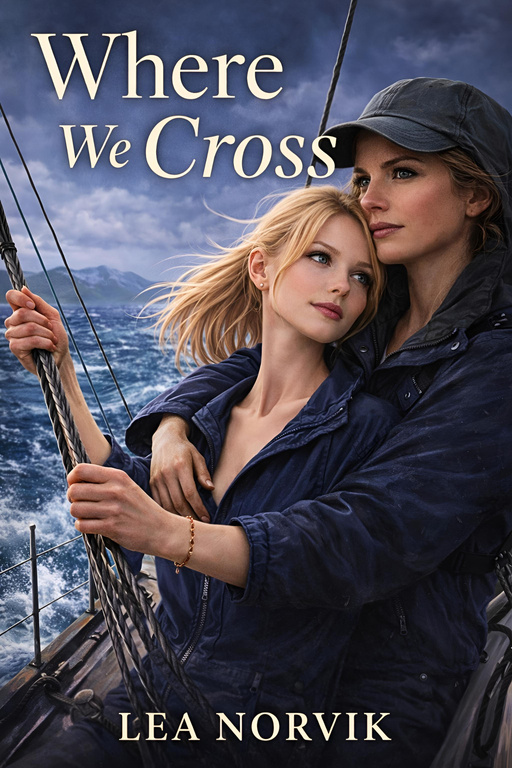
Emilia is good at leaving.
Light bag. Clean break. A skill perfected across three relationships and two countries. When a summer workshop position aboard a sailing flotilla in the Greek islands drops into her calendar, she takes it the way she takes everything: temporarily, and with one eye already on the exit.
Then Runa puts her on the helm.
The skipper doesn't explain. She corrects. Her authority operates through hands and weather and the precise placement of a body on a boat, and Emilia — who facilitates consent workshops for a living, who has language for every power dynamic she has ever studied — finds herself inside one that bypasses language entirely. The commands work. The daily life works. The woman works. By midsummer, Emilia has stopped looking for the exit.
But Runa's capacity has a wall in it. And Emilia's capacity has no walls at all.
When a woman from her past arrives in the same harbor, the geometry of the summer shifts. What Emilia confirmed on a midnight dock — that her ability to love in plural is permanent, not a phase — is the one thing Runa's architecture cannot hold. The limit, when it is spoken, takes twelve words. The devastation is in the honesty.
Where We Cross is a novel about the specific sadness of leaving something good because goodness cannot accommodate your full shape. It is about two people who love each other and cannot solve each other. It is about the morning after the decision, and the coffee still tasting right, and the bag that is always light enough to carry.
Book 4 in the Every Other Way series. Can be read as a standalone. Reading Books 1–3 deepens the history but is not required.
For readers of literary fiction with heat, emotional precision, and women who refuse to apologize for who they are.
Available as an eBook and paperback.
$7.99 USDEbookBuy on Amazon$16.99 USDPaperbackBuy on Amazon
PublicationAvailable
FormatsKindle eBook & Paperback
Publication dateMarch 30, 2026
Edition1st
Kindle print length357 pages
ISBN978-9190145609
eBook ASINB0GGZGBKSZ
Paperback ASIN9190145615
LanguageEnglish
ExtentFull-length novel
Paperback pages472 pages
Word count115,000 words
GenreLesbian romance
SeriesEvery Other Way
Book in seriesBook 4
PublisherUTP House
Read
Read an excerpt
At the corner near the fountain, the careless poly person from the long-table dinner appeared in full festival scale, louder here, hair tied in a scarf patterned with moons, touching someone’s elbow while kissing someone else’s cheek and telling a third person, “No, no, Mara is not my ex, Mara is my former disaster, which is a warmer category.” A moment later the same voice floated back through the crowd: “Ask Jules, Jules has been one of my people in four different countries.” Easy, unembarrassed, not asking permission from the air.
Emilia caught the line, stored it with no immediate use for it, and then lost the speaker again to color and bodies.
Petra passed in the opposite direction carrying a paper tray of grilled sardines and a plastic fork, talking over her shoulder to an older man about weather windows and diesel filters in German-accented English. “No, because if you think the fuel is clean here, you are a child,” she said, and kept moving.
By the time Emilia looped back toward the square, she had spoken to half a dozen people and been spoken to by twice that many. Not deeply. Not memorably in any one instance. But fully. A joke at a bread stall about loaves shaped like municipal decisions. A conversation with a woman from Crete about tattoos done at sea. A brief serious exchange with someone who was organizing tomorrow’s boat parade and pretending it was not organization because the word frightened festival people. Emilia moved through it the way she moved through rooms on land when the rooms were worth the energy—making contact, asking the question that opened instead of the one that pinned, laughing when there was anything to laugh at and not waiting for someone else to mark the rhythm first.
Listen
Listen to an excerpt
The audio sample slot is ready. A player will appear here when the recording is added.
Audio sample in preparation
Complete title informationWhere We Cross
Lesbian romance
Emilia is good at leaving. Light bag. Clean break. A skill perfected across three relationships and two countries. When a summer workshop position aboard a sailing flotilla in the Greek islands drops into her calendar, she takes it the way she takes everything: temporarily, and with one eye already on the exit. Then Runa puts her on the helm. The skipper doesn't explain. She corrects. Her authority operates through hands and weather and the precise placement of a body on a boat, and Emilia — who facilitates consent workshops for a living, who has language for every power dynamic she has ever studied — finds herself inside one that bypasses language entirely. The commands work. The daily life works. The woman works. By midsummer, Emilia has stopped looking for the exit. But Runa's capacity has a wall in it. And Emilia's capacity has no walls at all. When a woman from her past arrives in the same harbor, the geometry of the summer shifts. What Emilia confirmed on a midnight dock — that her ability to love in plural is permanent, not a phase — is the one thing Runa's architecture cannot hold. The limit, when it is spoken, takes twelve words. The devastation is in the honesty. Where We Cross is a novel about the specific sadness of leaving something good because goodness cannot accommodate your full shape. It is about two people who love each other and cannot solve each other. It is about the morning after the decision, and the coffee still tasting right, and the bag that is always light enough to carry.
Explore further More titles by Lera Norvik are available on the books page.
$7.99 USDEbookBuy on Amazon$16.99 USDPaperbackBuy on Amazon