
The story centers on river restoration, eel ecology in near future, and the politics of data, told through fieldwork, meetings, and public process rather than action-driven plot.
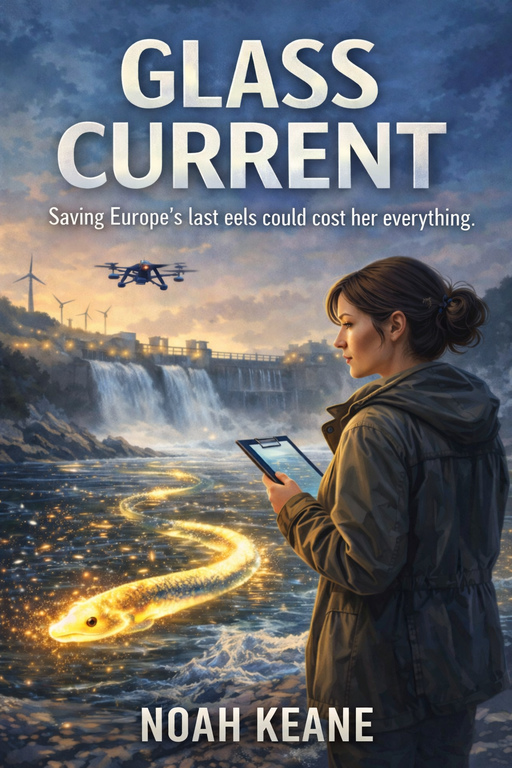
Available now
Glass Current
The Last Count · Book 1
When marine scientist Mira Calder finds an impossible spike in her river's data, she assumes it's a mistake. Then she's told to stop looking.
When marine scientist Mira Calder finds an impossible spike in her river's data, she assumes it's a mistake. Then she's told to stop looking. The Lifeline River was supposed to be Europe's flagship conservation success — proof that policy works, that governments listen, that endangered eels can be saved. The graphs say so. The press releases say so. The festival built around the river's recovery says so. But the numbers don't add up, and Mira knows it. What begins as a quiet disagreement over data becomes something far more dangerous: a collision between a scientist who won't stop counting, a fisherman who remembers what the river used to hold, a chef who built her reputation on a dish she can no longer serve, and an institution that needs its miracle to stay intact. As the annual festival approaches — cameras ready, politicians smiling — Mira and her allies face an impossible choice: protect their careers or expose a lie that runs from the local dam to the corridors of Brussels. Glass Current is a novel about what happens when the people closest to a crisis are the last ones allowed to speak. About data that won't lie even when everyone around it does. And about the stubborn, unglamorous work of paying attention to a river that is running out of time.
Available as an eBook and paperback.
PublicationAvailable
FormatsKindle eBook & Paperback
Publication dateFebruary 17, 2026
Edition1st
Kindle print length465 pages
ISBN978-9190145210
eBook ASINB0GNRL6KK2
Paperback ASIN9190145453
LanguageEnglish
ExtentFull-length novel
Paperback pages380 pages
Word count132 000 words
GenreContemporary literary fiction / Environmental fiction
SeriesThe Last Count
Book in seriesBook 1
Story scopeBook one in The Last Count series
ToneQuiet, precise, ethically tense; grounded rather than dramatic
PublisherUTP House
Realistic environmental storytelling, science under political pressure, slow-burn tension, and narratives about responsibility within large systems.
Themes of ecological decline, institutional pressure, public conflict, and moral stress; no graphic violence.
Read
Read an excerpt
He clicked. The next slide zoomed in on the last five years. The y-axis now started close to the current values, making the tiny bumps look like hills. “Here,” he said, “we see no statistically significant decline in recent years. The confidence intervals overlap. In some years, numbers are slightly higher than the previous. It would be irresponsible to claim we are ‘out of the woods’, but it’s equally misleading to say that nothing is working.” Erin felt her nails dig into her palm. He skipped quickly past the older years. The spike he’d constructed for the Brussels report hung there for less than a second before he clicked on. “A word on methodology,” he said. “All data are collected according to standardised protocols. Quality control is ongoing. Where anomalies appear, we investigate thoroughly. There is currently an internal review of server logging procedures to ensure full traceability, but we have no evidence of systemic errors that would change the overall picture.”
Listen
Listen to an excerpt
The audio sample slot is ready. A player will appear here when the recording is added.
Audio sample in preparationComplete title informationGlass Current
The river looks better on a slide than it does in the water.
The river looks like it’s recovering. The numbers say so.
Erin Calder is a field biologist working on the Lifeline River, part of a high-profile restoration project held up as proof that environmental repair is possible. Glass eels are counted, graphs are drawn, and progress is presented to funders and officials. From a distance, the story is reassuring.
Up close, it isn’t.
As Erin traces the data back to traps, logbooks, and code changes, small inconsistencies begin to surface—nothing dramatic enough to halt the project, but enough to raise questions no one wants asked. Around her, chefs, students, activists, and civil servants make their own quiet decisions about what they are willing to serve, publish, archive, or pause.
Glass Current is a novel about how environmental truth is produced, shaped, and sometimes softened to keep systems running. It follows the slow, careful work of watching a river honestly—and the cost of insisting that what is shown to the public still has a spine of truth.